Plant-Wide AI Control for Water and Wastewater Treatment
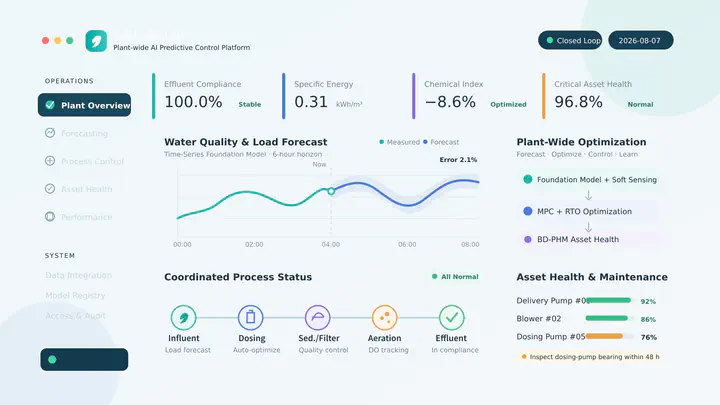 Concept interface for the plant-wide AIPC platform
Project Overview
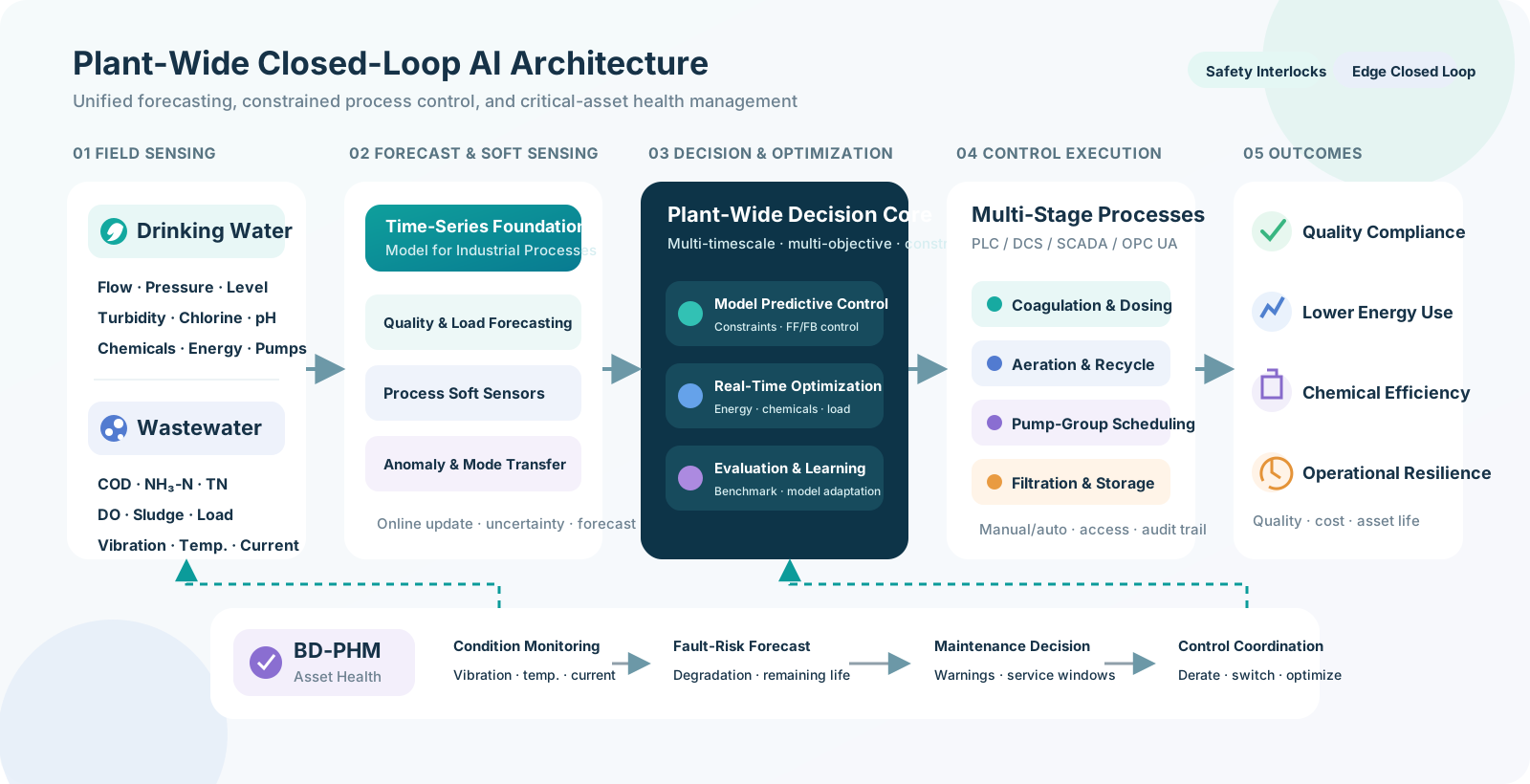
This project establishes a plant-wide closed-loop AI control system spanning sensing, forecasting, decision-making, control, and performance evaluation for drinking-water and wastewater treatment plants. It unifies time-series foundation models, soft sensors, multivariable model predictive control (MPC), real-time optimization (RTO), and prognostics and health management (PHM) within one industrial control architecture.
The platform integrates with existing PLC, SCADA, DCS, OPC UA, and industrial data systems. Existing safety interlocks and operator authority remain in place, while AI control strategies run online with continuous performance evaluation and model adaptation.
Core Technical Architecture
Multi-source industrial data integration
The platform combines flow, water-quality, pressure, level, energy, vibration, temperature, current, and operating-condition data in a unified plant-wide time-series foundation. It handles practical issues including asynchronous sampling, missing measurements, sensor drift, abnormal data, and operating-mode transitions.
Time-series foundation models and process soft sensors
Industrial time-series foundation models learn multivariable dynamics under strong coupling, long delays, and non-stationary operating conditions. Core capabilities include:
- Multi-horizon forecasting of influent flow, water quality, and pollutant load
- Soft sensing and trend forecasting for turbidity, residual chlorine, ammonia nitrogen, total nitrogen, and other key indicators
- Water-demand, network-pressure, pumping-load, and plant-wide energy forecasting
- Abnormal-condition detection, operating-mode transfer, and online model updates
Coordinated control of complex multi-stage processes
Local control loops are coordinated at plant level to address interactions and constraints across treatment stages:
- Drinking water: intake and pump scheduling, coagulation dosing, sedimentation and filtration, disinfection, clear-water-tank level, and distribution-network pressure
- Wastewater: influent-load forecasting, aeration and dissolved-oxygen control, recycle and sludge discharge, carbon-source and chemical dosing, advanced treatment, and energy optimization
- MPC and RTO jointly manage water-quality constraints, equipment capacity, production load, energy consumption, and chemical consumption
- A closed loop connects forecasting, optimization, execution, feedback, and continuous learning
Predictive maintenance of critical equipment
Operating and condition-monitoring data are combined for pumps, blowers, mixers, dosing systems, valves, and other critical electromechanical assets. The PHM layer provides:
- Detection of performance degradation and efficiency deviation
- Early warning of vibration, temperature, current, pressure, and operating anomalies
- Fault-risk forecasting and maintenance-window recommendations
- Coordination between equipment operating strategy and process-control strategy
Engineering Implementation and Software Interface
The system combines modular engineering software with edge controllers. Model configuration, control simulation, constraint management, and performance evaluation are completed in the engineering environment, while real-time control strategies are connected to the plant through industrial controllers. Each water project is configured for its actual process stages, instrumentation, access control, and industrial communication protocols.
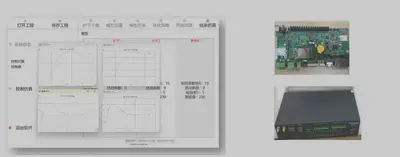
The image shows the laboratory’s existing predictive-control software and controller engineering foundation; it is not a screenshot from any specific water-treatment plant.
Main Application Modules
| Module | Controlled objects | Main capabilities |
|---|---|---|
| Time-series foundation model | Flow, water quality, load, pressure, and energy | Forecasting, soft sensing, anomaly detection, and online learning |
| Intelligent dosing control | Coagulants, disinfectants, carbon sources, and other chemicals | Feedforward-feedback control, chemical optimization, and quality constraints |
| Aeration and biological-process optimization | Blowers, valves, dissolved oxygen, and biological indicators | Multi-basin coordination, load tracking, and water-quality/energy balancing |
| Pump-group control and scheduling | Intake, lift, delivery, and booster pumps | Best-efficiency-region operation, pressure/level coordination, and peak-load optimization |
| BD-PHM equipment health management | Pumps, blowers, valves, dosing, and mixing equipment | Condition monitoring, fault prediction, and maintenance decisions |
| Plant-wide multi-objective optimization | Water quality, production, chemicals, energy, and equipment life | Constrained optimization, process coordination, and performance evaluation |
Industry Collaboration
The team has established long-term cooperation with leading industry partners including Nanfang Pump Industry and Beijing Enterprises Water Group (BEWG), covering algorithm validation, engineering implementation, platform integration, pump-system energy optimization, critical-equipment health management, and scaled deployment.
The modular architecture supports deployment from a single process unit and progressive expansion to plant-wide AI control. It is suitable for both intelligent construction of new plants and phased upgrades of existing facilities while preserving their current control systems.